Journal of Biomedical Nanotechnology
Volume 1, Number 1 (March 2005)
EDITORIALWelcome to Journal of Biomedical Nanotechnology!
Challa S. S. R. Kumar Pages
1–2
Abstract Full Text -
PDF Purchase Article Reviews
Applications of Carbon Nanotubes in Biotechnology and BiomedicineElena Bekyarova, Yingchun
Ni, Erik B. Malarkey, Vedrana Montana, Jared L. McWilliams, Robert C.
Haddon, and Vladimir Parpura
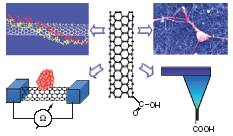
This review discusses the properties, purification and chemical modification of carbon nanotubes, and underlines the scope for their utilization in biosensors, assembly of functional structures and devices, scanning probe microscopy, as carriers for the delivery of molecular probes into mammalian cells, and as substrates for neuronal growth. Pages 3–17 Abstract Full Text - PDF Purchase Article A Review of Nanotechnology for the Development of Better Orthopedic ImplantsGrace E. Park and Thomas J. Webster
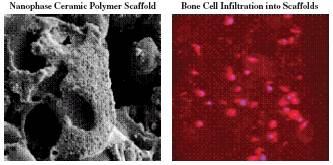
This review covers recent advancements made at the intersection of nanotechnology and orthopedic implants. Nanomaterials studied include ceramics, metals, polymers, and composites thereof. A composite of nanophase titania and poly-lactic-co-glycolic acid (left) with enhanced bone cell infiltration needed for implant success (right—cell are red) are pictured here. In all material cases, bone cell function is enhanced on nanophase materials. Pages 18–29 Abstract Full Text - PDF Purchase Article Research Articles
Sensing Interactions between Vimentin Antibodies and Antigens for Early Cancer DetectionC. Milburn, J. Zhou, O. Bravo, C. Kumar, and W. O. Soboyejo
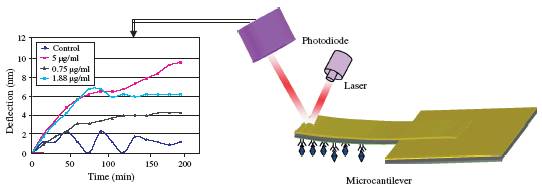
This paper examines the use of polysilicon microcantilevers in the bioassay of Vimentin antigens that are present in human-osteosarcoma (HOS) cells. The developed method has potential application in early cancer detection that is extremely critical to improve cancer treatment. Pages 30–38 Abstract Full Text - PDF Purchase Article Nanoscale Modification of Supported Lipid Membranes: SynergeticEffect of Phospholipase D and Viral Fusion PeptidesKarim El Kirat, Laurence Lins, Robert Brasseur, and Yves F. Dufrêne
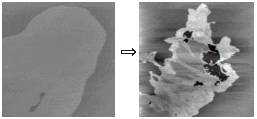
Nanomodification of a DOPC/DPPC bilayer (left; 10 µm × 10 µm AFM image) with an AFM tip functionalized with phospholipase D dramatically enhances subsequent interaction with the simian immunodeficiency virus (SIV) fusion peptide: at short incubation time, the SIV peptide induces a thickness reduction of the DPPC domains, while at longer incubation time depressed domains transforms into elevated striated domains (right image). Pages 39–46 Abstract Full Text - PDF Purchase Article Extra-/Intracellular Biosynthesis of Gold Nanoparticlesby an Alkalotolerant Fungus, Trichothecium sp.Absar Ahmad, Satyajyoti Senapati, M. Islam Khan, Rajiv Kumar, and Murali Sastry
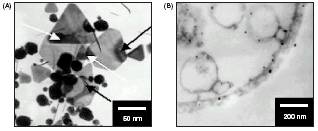
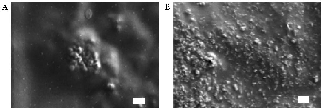
The biosynthesis of gold nanoparticles of variable shape using the fungus Trichothecium sp. is described: reacting aqueous gold ions with the fungus under stationery (A)/shaking (B) conditions results in extracellular/intracellular gold nanoparticles. Pages 47–53 Abstract Full Text - PDF Purchase Article Surface Engineering of Nano-Fibrous Poly(l-Lactic Acid) Scaffolds viaSelf-Assembly Technique for Bone Tissue EngineeringXiaohua Liu, Laura Smith, Guobao Wei, Youngjun Won, and Peter X. Ma
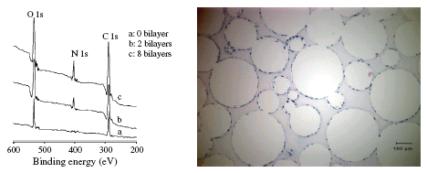
Nano-fibrous PLLA materials have been developed to mimic collagen in morphology. Gelatin was immobilized onto the pore surface of macro-porous and nano-fibrous PLLA scaffolds via a layer-by-layer technique to impart the chemical composition of collagen (left: XPS spectra). The surface modification significantly enhanced osteoblast adhesion and proliferation in the scaffolds (right: histology). Pages 54–60 Abstract Full Text - PDF Purchase Article Galactosylated Polymeric Nanoparticles: Synthesis andAdhesion Interactions with Escherichia coliLiangwei Qu, Lingrong Gu,
Huaping Li, Shelby Taylor, Tara Elkin, Pengju G. Luo, Tzuen-Rong J. Tzeng, Xiuping Jiang, Robert A. Latour, Fred Stutzenberger, Alicia Williams, and Ya-Ping Sun
Polymeric nanoparticles of a polystyrene core and polyethylene glycol corona were prepared via dispersion copolymerization of styrene with a specifically synthesized macromonomer. The particle surface tethers were terminated covalently with derivatized galactose moieties. Bioactivities of the nanoparticles were evaluated and demonstrated by their significant adhesion interactions with several Escherichia coli strains. Pages 61–67 Abstract Full Text - PDF Purchase Article Anodized Ti and Ti6Al4wV Possessing Nanometer SurfaceFeatures Enhances Osteoblast AdhesionChang Yao, Venu Perla, Janice L. McKenzie, Elliot B. Slamovich, and Thomas J. Webster
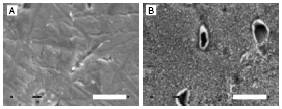
SEM images of the surfaces of Ti6Al4V before anodization (A) and after anodization (B). Bar = 1 µm (30,000X). Results of this study showed that osteoblast adhesion is enhanced on anodized Ti6Al4V and Ti. Pages 68–73 Abstract Full Text - PDF Purchase Article Sustained Proangiogenic Activity of Vascular Endothelial Growth FactorFollowing Encapsulation in NanoparticlesJasmine Davda and Vinod Labhasetwar
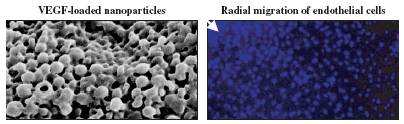
Vascular endothelial growth factor encapsulated in biodegradable nanoparticles (pictured on left) demonstrated greater and more sustained effect than the protein used as a solution on endothelial cell proliferation, migration, and morphogenesis (pictured on right), the key elements of angiogenesis. Pages 74–82 Abstract Full Text - PDF Purchase Article Increased Osteoblast Functions on (poly-lactic-co-glycolic acid)with Highly Dispersed Nanophase TitaniaHuinan Liu, Elliott B. Slamovich, and Thomas J. Webster
SEM images of nanophase titania/PLGA composites not sonicated (A) and sonicated at 166.25 W for 10 minutes (B). Bar = 1 µm. Results of this study showed that osteoblast functions are enhanced on nanophase titania well dispersed in PLGA composites. Pages 83–89 Abstract Full Text - PDF Purchase Article Vibrational Modes of Nano-Template VirusesAlexander A. Balandin and Vladimir A. Fonoberov
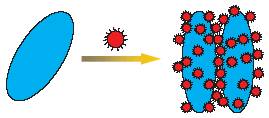
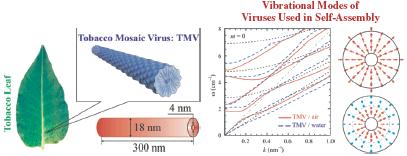
The rod-shaped viruses such as TMV and M13 bacteriophage have been recently proposed as nano-templates for chemical self-assembly of nanoelectronic circuits. In this paper we report results of our investigation of the low-frequency vibrations in such viruses immersed in air and water. We analyze the damping of vibrations in water and discuss application of the micro-Raman spectroscopy for in-situ monitoring of the virus-based self-assembly of nanoelectronic circuits. Pages 90–95 Abstract Full Text - PDF Purchase Article Design Variations for An Aptamer-Based DNA NanodeviceStefan Beyer, Wendy U. Dittmer, and Friedrich C. Simmel |